Grotonsciencegeek is evolving! For the new year comes a new look. I had to update the template of the blog due to some changes that Blogger made about a year ago. Stay tuned for a new look and new features. Please be sure to let me know if you're having trouble locating something.
Have a great Holiday season with family and friends!
19 December 2008


18 December 2008
Wake Up, Freak Out - then Get a Grip from Leo Murray on Vimeo. Here is a good video I found regarding the current climate crisis.
15 December 2008
14 December 2008

11 December 2008
 Today we saw firsthand how saltwater affects cells. After we added salt to our elodea leaf the high concentration of water within the cell membranes quickly rushed out of the cell, leaving a shrunken membrane within the cell wall skeleton. The technical word for this is osmosis. This also explains why you get thirsty after eating something salty and why Magellan's crew couldn't drink sea water during their voyage (right Mr. Filzen's students??)
10 December 2008
Here's a quick update on our trout. Here are 2 pictures at 6 weeks of development. All yolk sacs have pretty much been absorbed into the fish and most are now actively feeding on fish food from the top. The above picture is of our lone deformity. We had 5 fish die since the beginning but this one had a mutation where (from what we can decipher) the yolk sac was enclosed within the fishes belly. This skin did not recede as the yolk sac did, leaving this bubble. The bottom represents a typical healthy Brown Trout.


09 December 2008
Today, Cornell Junior, Inga Conti-Jerpe stopped by to share her expertise on turtles. She even brought in her pet Red-eared Slider. Thanks Inga for giving us your time.


08 December 2008

 Today's bird watchers made an excellent observation. In addition to six different species of birds we witnessed a yellow-bellied sapsucker feasting on our suet block for nearly 10 minutes. According to the map, it is very rare to have them in this area at this time of year. This was also a first for Mr. DeVoe. He has never seen them at the school feeder nor his home feeder. All data from our feeder is submitted to Cornell at www.ebird.com.
03 December 2008
02 December 2008

 Some really good 3D cell projects have been handed in this week and many high grades were earned. I hope this helped everyone realize that cells come in a variety of shapes depending on what the cell is specialized to do. My favorite cell was probably ERIN I.'s. Her design was truly original and she did a nice job on the organelle sheet as well. My sub-par photography skills fail to capture it in it's true elegance. Good luck everyone on tomorrow's test.
 Please study for tomorrow's cell test. Here is the micrograph we took yesterday of the elodea plant cell. I labeled the major visible parts. Here are the important concepts to study:
1. The organelles and functions
2. The 3 parts of the cell theory
3. The organelles found only in plant cells
4. Be able to label a plant cell
Also, cell projects were due today and they lose 5 points every day they are late. Please get yours in ASAP!
26 November 2008
I was hoping to have a class discussion on Thanksgiving and what it means to everyone but, of course, I have been out of school for an educational technology conference. What has come to bother me over the past several years are individuals that take too many things for granted...people that complain of being bored when there is so much beauty in the world, accomplishments to be made, and knowledge to attain. I applaud this year's 7th grade class. Not once have I heard "I hate this school" or "Groton is poor". This is a sign that the students appreciate our school and respect their surroundings. The students are polite and I would love to see more of these positive aspects. I have compiled a short list of 20 things that I try not to take for granted...all things that I feel truly lucky for.
My health
Working with the best teachers in the area
Supportive parents
Birds
Books
Candlelight
Diversity in human beings
A warm night and a sky full of stars
Groton and the surrounding area
Nature and all that lives as a part of it
Music
A supportive principal
People that care
People that are interesting
Mountains
My five senses
Running water
Optimism
Heat/Electricity
Time
If you find time, please comment to give your list. If you're too embarrassed, just post as anonymous or make a pen name (and tell me later). I'll give a couple extra credit points for participating (and checking the blog over break). Have a great Thanksgiving.
-Mr. DeVoe
My health
Working with the best teachers in the area
Supportive parents
Birds
Books
Candlelight
Diversity in human beings
A warm night and a sky full of stars
Groton and the surrounding area
Nature and all that lives as a part of it
Music
A supportive principal
People that care
People that are interesting
Mountains
My five senses
Running water
Optimism
Heat/Electricity
Time
If you find time, please comment to give your list. If you're too embarrassed, just post as anonymous or make a pen name (and tell me later). I'll give a couple extra credit points for participating (and checking the blog over break). Have a great Thanksgiving.
-Mr. DeVoe
21 November 2008

19 November 2008
Today we're going to extend our study of cells by utilizing the laptop cart and internet. In your groups please run through the following exercises.
1. Click here. Select either the plant or animal cell. Go through each organelle and read the descriptions with your partner.
2. Check out this site. Read through the descriptions of each organelle and click the interactive buttons. Click the back button after each one and do the others.
3. Fill out this survey when you are completed with the above websites.
UPDATE: Check out the entries here.
I particularly liked Cameron and Paige's entry: "We learned that lysosomes look like cocoa puffs, everything looks cooler close up and the ribosomes look like popcorn. Not for real. We really learned that the golgi packages and distributes protiens to the other cell organaelles (awesomely). We also learned cytoplasm is the liquid inside the cell."
Here is some video from today's research.
1. Click here. Select either the plant or animal cell. Go through each organelle and read the descriptions with your partner.
2. Check out this site. Read through the descriptions of each organelle and click the interactive buttons. Click the back button after each one and do the others.
3. Fill out this survey when you are completed with the above websites.
UPDATE: Check out the entries here.
I particularly liked Cameron and Paige's entry: "We learned that lysosomes look like cocoa puffs, everything looks cooler close up and the ribosomes look like popcorn. Not for real. We really learned that the golgi packages and distributes protiens to the other cell organaelles (awesomely). We also learned cytoplasm is the liquid inside the cell."
Here is some video from today's research.
18 November 2008


 Today Oliver Schaufelberger did a wonderful presentation for us on bird migrations. If you ever get a chance you should check out Montezuma Wildlife Refuge in the springtime to see these amazing migrations. This talk was a great way to kick off Project Feederwatch which we will start after Thanksgiving break.
17 November 2008
 Today Sarah Chang, a junior from Cornell, stopped by to do a presentation on endangered species. She did a great job explaining the causes for many of these species' declines including illegal hunting, habitat destruction, and pollution. Something I enjoyed learning more about was the Karner Blue Butterfly. These used to be common in this area but are now limited to a few areas in the Albany area.
 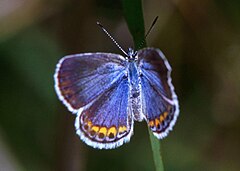 She also spoke of the great success story that is the Bald Eagle. I was glad to hear that many students have been to Montezuma Wildlife Refuge near Auburn and some have even seen Eagles there.


 Saturday the Sisterhood of Science traveled to Taughannock Falls State Park for a guided tour of the local geology of that area. Despite the rain it was still a good time. Special thanks to the Museum of the Earth for leading the tour. The Sisterhood of Science is a special program for Groton 7th and 8th grade girls. It is run by the Cornell Nanobiotechnology Center.
Subscribe to:
Posts (Atom)